Search


How is your hearing? Is it good as it was a year ago? How do you know? Hearing loss is less obvious than the loss of other senses. It generally occurs slowly over several years, and you may not even realize it.
The three major parts of the human ear are outer, middle and inner, including the auditory nerve. Sounds of minute intensity can be detected and sounds of extreme intensity can be tolerated by the normal ear – perhaps 100 trillion (1014) times more powerful than the faintest sound they can perceive. We suffer pain or even a ruptured ear drum if sound gets too strong.
The normal human ear is adapted to wide differences in sound. It can hear the peep of a newborn chick or the blast of a shotgun. However, unlike our eyes, our ears do not have protective covers and cannot screen or soften noises.
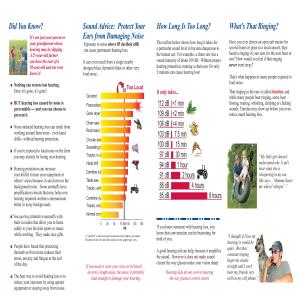
Sound is usually measured in decibels. Values range from 0 to 140 – the threshold of pain. Decibels are logarithmic units of pressure and can’t be added or subtracted. Doubling the amount of sound pressure energy results in a three decibel increase. For example, if two tractors are running side by side and each puts out 90 decibels of sound, the combined sound level would be about 93 decibels and not 180. Because the ear also hears logarithmically, the two tractors would not sound twice as loud.
Many people mistakenly assume that a few decibels increase is not significant when, in fact, every three decibels increase in the sound represents a doubling of the sound pressure energy that the ear receives.
The ear can detect changes in sound frequency or pitch. The limit of human hearing is approximately 20 to 20,000 hertz (or cycles per second). The low notes of a tuba or organ would be approximately 20 hertz. The 20,000 hertz might be reached by a violin or other high-pitched instrument. As people age, the high range usually declines to 12,000 to 15,000 hertz, and they are less able to hear the higher-pitched sounds.
Low-frequency sounds (below 1,000 hertz) usually predominate in agriculture and are measured on the “A” scale of the sound meter. The “A” scale responds to sound more or less the same as the human ear. The values are given in units of dB(A) or decibels on the “A” scale. Other sound weighing scales -- B, C and D -- that correspond to higher frequencies are also available.
A person’s hearing threshold is the lowest value (in decibels) that he can hear. Abusing the ear with loud sounds shifts a person’s hearing threshold upward, and he can hear only the louder sounds. Maybe you’ve experienced this after operating noisy equipment for several hours. When you stop, your ears ring and your hearing doesn’t seem normal. Hearing will usually return to normal overnight. However, repeated exposure will eventually result in a permanent threshold shift and measurable hearing loss. It is much like grass being walked on. The first time or two that it is walked on, it springs back and recovers. After being repeatedly walked on, it stays matted down and shows signs of abuse.
One study reported hearing losses above the frequency of 1,000 hertz, with a maximum loss occurring at the 4,000 hertz level, especially in the 30- to 49-year-old age group. High frequency losses are most common in people between 30 and 60 years old.
Studies at Michigan State University have shown that farmers have greater hearing losses than people of some other occupation. This may be partly due to the frequent and continuous operation of noisy equipment.
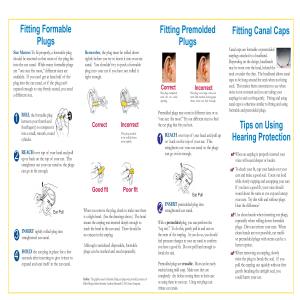
Using some sort of hearing protection in noisy situations – earplugs or muffs – helps prevent hearing loss. It usually helps a person hear spoken words better, too, because it reduces the low-frequency sound coming to the ears. If you are aware of possible sources of noise damage, protect yourself by using protective devices. Certain regulations require hearing protection whenever the sound level exceeds 90 decibels on the “A” scale if you are exposed continuously (8 hours or more).
Here are some general recommendations to help protect your hearing:
· Consider quiet operation when shopping for tractors and farm machinery.
· Use ear protection for all noisy jobs.
· Keep your equipment well lubricated and maintained.
To learn more about hearing safety visit the CDC’s Noise and Hearing Loss Prevention website. Visit the Nebraska Tractor Test Laboratory to learn how noisy your tractor may be.