The Louisiana State Arthropod Museum (LSAM) and Department of Entomology provide insect diagnostic services to Louisiana residents, stakeholders, and the research community. See below for details of our offered services. Contact InsectIdentifications@agcenter.lsu.edu for questions or a consultation on our services.
Starting July 1st, 2026, the suggested donation amounts are listed below
| Service | In State | Out-of-State** |
| Online image submission | $5 | $10 |
| Taxonomic diagnosis (routine ID) | $20 | $40 |
| PCR screening (genetic ID) | $100 | $150 |
| Bulk sample screening * | $25/hr | $45/hr |
Online Image Submission
Louisiana residents may submit insect images to our online portal for general identification. There is a $5 suggested donation for this service. Follow the instructions below
Step 1. Take a clear photo of the insect. Our ability to identify it depends on our ability to see specific features. Including a reference item to help determine size is encouraged.
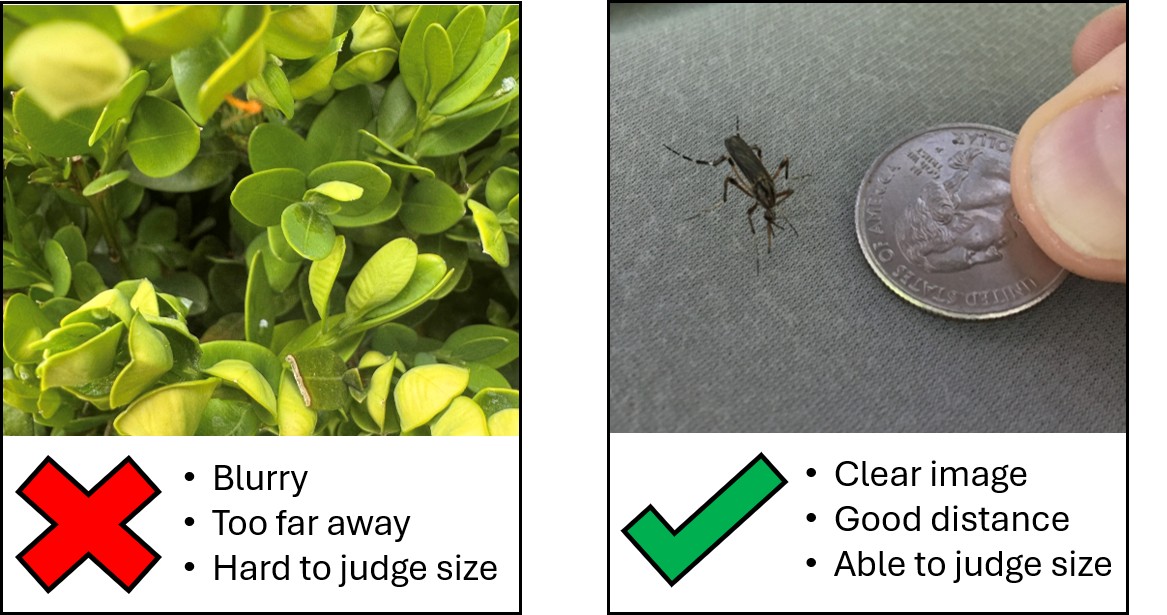
Step 2. Fill out and submit the submission form in
Please include:
- Location and habitat information: City, Parish, and where the insect was found.
- Behavior, appearance, frequency of contact, and other relevant information.
DO NOT SUBMIT
- Inappropriate or vulgar photos.
- Photos of bites, bodily products, or other images related to personal health. We will not provide medical diagnoses or medical advice. Contact a medical professional. We ID insects.
Physical specimen submission
Intact and well-preserved specimens will provide the best chance for accurate identification. Please kill any insects prior to mailing them to us. Consider submitting a photo prior to sending specimens. Instructions for submitting specimens are below. Contact us before sending specimens, InsectIdentifications@agcenter.lsu.edu.
Step 1. Collect the specimen. Place insects in sealed container, e.g. a small plastic vial, pill bottle, small Ziplock bag, or similar.
- For small or soft bodied insects, place them in rubbing alcohol or ethanol (at least %70).
- For small insects or insects that are on the skin, you can use tape to collect and then seal the organism between the two layers of tape. Sticky traps can also be enclosed within a container for shipping. Do not send traps with small mice, etc.
- Be sure to note location and habitat of collected specimen
Step 2. Euthanize the insect. Please do not send live insects.
- If not in alcohol, place the insect sample in the freezer overnight to kill it.
Step 3. Contact us.
Step 4. Send the specimen.
- Ship the specimen in a small box or padded envelope (something that won’t crush the insect) to the address below.
Include in the package:
- Dead specimen in a tightly seal container. Please do not send live insects.
- Name and contact information
- Description of where specimen was collected (City or Parish, habitat)
Shipping Address:
Department of Entomology
Attn: LSAM Insect Specimen ID
404 Life Sciences Building
Louisiana State University
Baton Rouge, LA 70803
PLEASE DO NOT SEND THE FOLLOWING:
- LIVE insects. Insects must be dead and preserved before placing in the mail.
- Do not send any bodily tissues and/or fluids, including blood, stool, urine, semen, skin, or hair samples. We ID insects.
- Do not send vacuum cleaner samples.
- Do not send worms, snails, slugs, frogs, turtles, or other animals.