Search
Lucas Stamper, Wallace, Whitney, Guo, Jinggang, West, Valerie

Download Publication ID:
Luke Stamper, PhD, Extension Wildlife Specialist, LSU AgCenter
Managing forage for white-tailed deer presents a range of challenges for land managers, challenges that can be both highly rewarding and, at times, frustrating. A common question I receive following cool-season and warm-season plantings is: “Why is my food plot not performing as expected?” Rather than exploring every possible reason for food plot failure, this article offers a practical starting point, an observational tool that any manager can incorporate into their forage management program.
One of the primary issues with food plots is that biomass production is continuously removed by deer and other wildlife. This constant grazing pressure can lead to an inaccurate assessment of how well a plot is actually performing. In areas with high deer densities, plant establishment may be severely limited, or even nonexistent, due to the sheer number of animals feeding on newly emerging vegetation.
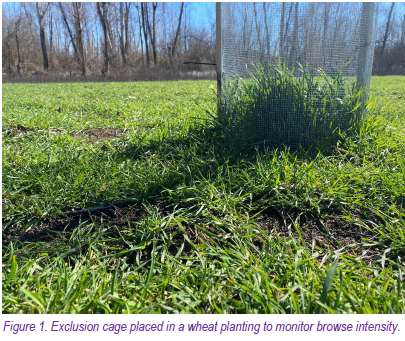
A simple and effective solution to this problem is the use of exclusion cages (Figure 1.), structures designed to prevent animals from grazing a designated portion of the food plot. By comparing forage growth inside the cage (excluded from grazing) with the surrounding area (subject to grazing), land managers can make more informed decisions about food plot performance and management strategies.
The design of an exclusion cage can vary depending on available materials and personal preference, but several basic requirements must be met for the cage to function effectively. The cage should be approximately 4 to 5 feet tall to prevent deer from reaching over the sides to feed. It should also be small enough in diameter, around 16 square feet, to prevent deer from jumping inside. A wire mesh with openings small enough to prevent deer from inserting their heads through the sides is ideal. To ensure stability, the cage should be anchored securely to the ground using rebar or T-posts, fastened with wire or heavy-duty zip ties. While the shape of the cage is not critical, circular designs tend to be easier and more cost-effective to construct, requiring fewer fastening points. Square cages, by contrast, require securing at four corners, which can be more time-consuming and require additional materials.
Strategically placed exclusion cages offer valuable insights that can enhance a management program. One of the most immediate benefits is the ability to assess grazing pressure associated with local deer density. By comparing forage growth inside and outside the cage, managers can gauge the intensity of grazing. If vegetation inside the cage is significantly taller and more productive than outside, it may indicate a high deer density or poor-quality habitat. In such cases, management actions could include adjusting harvest quotas, enhancing native vegetation, or increasing the acreage planted in forage species. Conversely, if forage height is similar both inside and outside the exclusion cage, it may indicate low grazing pressure, possibly due to the availability of more preferred food sources at that time, or because the habitat is adequately supporting the local deer population without being over browsed.
Exclusion cages also help identify which plant species deer prefer. This is useful for evaluating both cultivated and native species. For example, exclusion cages have shown that sunn hemp, cowpeas, and soybeans were grazed first out of a 12-species warm-season blend (Figure 2.). This type of insight can inform future decisions when customizing forage blends to better align with deer preferences or to achieve specific management objectives, such as improving nutrition or enhancing hunting opportunities.
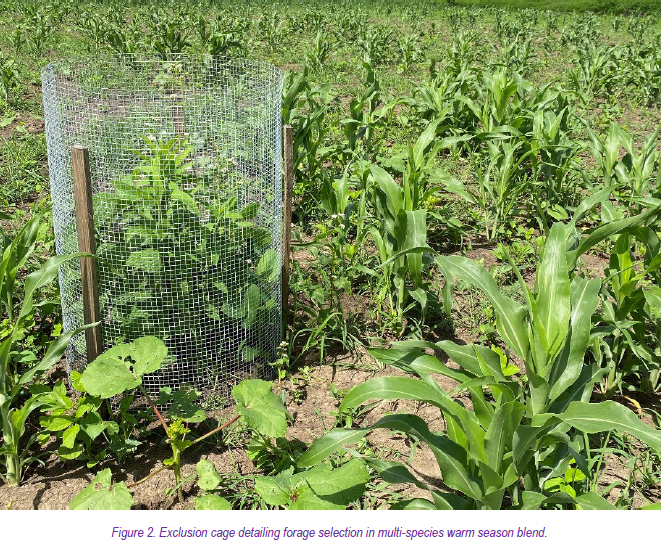
Perhaps the most valuable contribution of exclusion cages is their role in assessing plot establishment. This is especially important for absentee landowners who may not be able to monitor plots regularly. Instead of speculating whether poor establishment was due to fall armyworms, drought, low seeding rates, or excessive grazing, managers can simply compare vegetation inside and outside the cages to identify the likely cause.
It’s never too late to install exclusion cages in your food plots. I encourage you to do so and begin monitoring the forage production you’ve worked hard to establish. These simple tools can provide powerful insights that improve your management decisions and ultimately benefit the health of your deer herd and habitat.
Jinggang Guo, PhD, Forest Economist, LSU AgCenter
The third quarter brought widespread price corrections across Louisiana’s timber markets. Pine sawtimber, which serves as a key indicator for the overall market, fell 19.1% to $23.95 per ton, giving back the gains achieved in the second quarter. The steepest decline came in hardwood pulpwood, which dropped 26.0% to $6.25 per ton, reflecting serious supply-demand imbalances in the pulp sector. Not all segments struggled, however. Mixed hardwood sawtimber stood out as the quarter’s strongest performer, climbing 10.0% to $41.52 per ton and continuing its impressive year-over-year growth of 24.2%. Other products experienced more modest changes, with oak sawtimber edging down 0.8% and pine chip-n-saw declining 2.9%.
Table 1. Average Stumpage Prices ($/ton) Q3/2025
| Product | Q3/2025 | Q2/2025 | Q3/2024 | Q3/Q2 % Change | Q3/Q3 % Change |
|---|---|---|---|---|---|
| Pine Sawtimber | 23.95 | 29.60 | 22.94 | -19.1% | 4.4% |
| Oak Sawtimber | 44.06 | 44.43 | 43.53 | -0.8% | 1.2% |
| Mixed Hardwood Sawtimber | 41.52 | 37.73 | 33.43 | 10.0% | 24.2% |
| Pine Chip-n-Saw | 18.02 | 18.55 | 17.76 | -2.9% | 1.5% |
| Pine Pulpwood | 4.99 | 4.74 | 5.17 | 5.3% | -3.5% |
| Hardwood Pulpwood | 6.25 | 8.45 | 6.24 | -26.0% | 0.2% |
Data source: TimberMart-South 2025
The decline in pine sawtimber prices directly reflects reduced demand from the construction sector. High interest rates continue to dampen new home construction and remodeling projects, leading to lower lumber consumption. While the U.S. South remains positioned for long-term lumber production growth, current market conditions have pushed Southern pine prices to historically low levels when adjusted for inflation. Louisiana’s 19.1% quarterly decline mirrors this regional trend, with sawmills reducing production in response to weak demand.
Louisiana’s pulpwood sector faces extraordinary pressure from both local and regional mill closures. The shutdown of International Paper’s Red River containerboard facility in Campti removed significant buying capacity from the market, contributing largely to the 26.0% collapse in hardwood pulpwood prices. This local challenge is compounded by a broader regional crisis – seven pulp mills have closed across the U.S. South since 2023, reducing the region’s pulp capacity by more than 15% since 2020.
Despite broader market challenges, Louisiana’s hardwood sawtimber sector continues to perform well. The 10.0% quarterly increase in mixed hardwood sawtimber prices reflects sustained demand from export markets, particularly in Asia, and domestic specialty lumber applications. High-quality hardwood remains in demand for furniture, flooring, and architectural millwork, providing stable returns for landowners with well-managed hardwood stands.
The near-term outlook remains challenging for pine products until interest rates are moderate and construction activity recovers. Industry analysts expect continued volatility in pine sawtimber markets through early 2026, with prices likely remaining below historical averages. The pulpwood situation appears more structural than cyclical. With additional mill closures possible and no new facilities planned for Louisiana, pulpwood markets may face extended weakness. Landowners should consider alternative management strategies, including longer rotations aimed at sawtimber production rather than pulpwood.
Forest landowners should work closely with consulting foresters to adjust management plans based on these market realities, focusing on species and products with the strongest demand outlook while maintaining flexibility for changing conditions.
Valerie West, PhD, Extension Forestry Agent, LSU AgCenter
Whether you have just harvested a tract or recently purchased a tract that you want to put into timber production, it is helpful to understand what seedling options are available. The most abundant and affordable seedling options on the market are loblolly pine. A wide range of choices are available in loblolly pine but understanding what you are getting may be confusing.
There is a classification system for all genetically improved tree seedlings. In this system, the term ‘generation’ is used to describe the level of parent tree selection and breeding. It begins with the selection of visually superior trees in natural stands. Foresters collect material from those individuals and graft them onto root stock in a seed orchard. A seed orchard is an isolated area where selected trees are grown to produce genetically improved seeds. Think of a fruit orchard but instead of peaches or apples they grow pinecones! Here is how the system works:
1.0 Generation (First Generation): Seedlings from trees selected for desirable traits from natural stands. This tends to be a seed orchard mix of open pollinated cones from multiple trees within the orchard.
1.5 Generation: Seedlings from seed orchards established with grafts from the best 1.0 generation trees. These seedlings are produced by open pollination in the orchard but in this case, the specific female parent is known.
2.0 Generation (Second Generation): Seedlings produced from controlled crosses of superior 1.0 generation trees. Under controlled conditions, pollen from one parent is used on the cones of another parent, excluding any other pollen from the cones while they are receptive. This means that both parents are known.
3.0 Generation (Third Generation): Seedlings from controlled crosses of the best trees from 2.0 generation orchards.
It is not unheard of to have 2.5, 3.5, 4.0, or even 4.5 generation seedlings available for purchase. Each level of generational increase represents increasing levels of genetic improvement. Later generations offer improvements in traits like faster growth, disease resistance, and better form. It is important to note that some early selections will still outperform later ones, especially if the seedlings selected are not compatible with the geographic location of your tree farm. A consulting forester or seedling sales representative from your area will be your best source of information to avoid purchasing seedlings that are not adapted for your area. Additional terms like "Advanced," "Select," and "Elite" are also used to delineate between 1.5, 2.0, and 2.5/3.0 generations, respectively. Mass Control Pollinated (MCP®), or Controlled Mass Pollinated (CMP) seedlings typically offer superior genetic value by precisely controlling both parents, thus an increase in cost per seedling to the landowner. Varietal seedlings are those produced not from seed but from cloned embryos (somatic embryogenesis) or vegetative cuttings that have been rooted from superior performing tree lines resulting in genetically identical seedlings. This increases the cost of the seedlings.
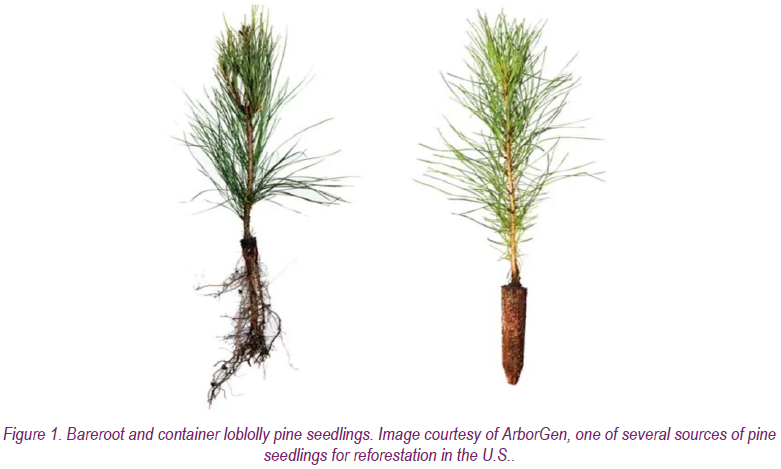
Now is the time to order tree seedlings for 2026/2027. This will allow nurseries to plan for your seedling needs. It takes one year in the nursery to grow a typical bareroot loblolly pine seedling for reforestation. These seedlings are referred to as 1-0 seedlings. Containerized seedlings are also available from many nurseries. Rather than being planted in a field, these are planted in individual containers and take the same amount of time to grow into a seedling for planting. Here is a chart (figure1.) comparing important features of bareroot and container seedlings.
Table 2. Comparison of 1-0 bareroot pine seedlings and containerized pine seedlings.
| Feature | 1-0 (Bareroot) Seedlings | Containerized Seedlings |
|---|---|---|
| Growth environment | Grown in open fields and then lifted, with all soil removed
from the roots for shipping. | Grown in individual containers with a specific growing
medium that surrounds the roots. |
| Root system | More susceptible to damage during the lifting, shipping, and
handling process, as the roots are exposed. | Roots are protected by the container and soil medium, which
significantly reduces damage and transplant shock. |
Planting season | Restricted to the dormant season, typically December through mid-March in the South. | Can be planted over an extended season, mid-September
through mid-May, depending on moisture conditions. |
Survival rate | High survival rates (85−90%) are common on good sites with
proper planting and site preparation. | Offers higher survival rates, especially on challenging or
drought-prone sites where rates can exceed 95%. |
Cost | More economical, often costing between one-half and
one-third the price of containerized seedlings. | More expensive per seedling due to the increased cost of
production. |
Growth on harsh sites | Can experience more stress and have lower survival on dry or
challenging sites due to root disruption. | Often performs better and has a higher survival rate on
harsh sites, such as those with well-drained, sandy soil. |
| Planting considerations | Best for large-scale reforestation projects where cost is a
major factor. | Offers more planting flexibility and convenience, but the
containers can be bulky to transport. |
| Early root growth | Focuses energy on re-establishing its root system for the
first 4 to 6 weeks after planting. | Because the root system is undisturbed, the seedling is
ready to grow as soon as it is planted, which may shorten the rotation time. |
Site preparation | Good site preparation is critical for success, and survival
can be impacted by poor drainage or soil conditions. | Does not substitute for proper site preparation, but the protected root system can help mitigate the effects of certain stressors. |
If you have further questions about pine seedling choices, need information on where to purchase seedlings, or any other reforestation questions, please contact your regional forestry extension agent.
Whitney Wallace, LSU AgCenter Forestry Agent – Southeast Region
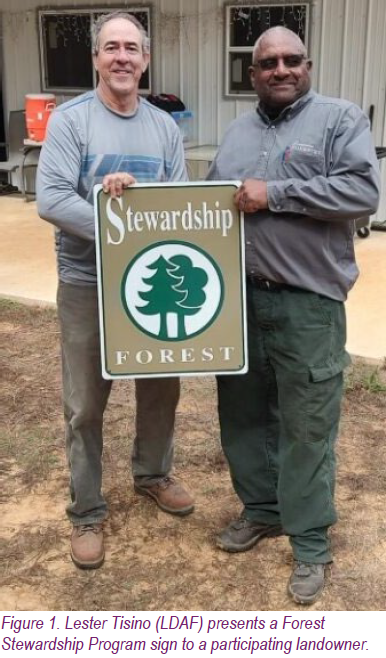
This voluntary program encourages landowners with at least 10 acres to work with a professional forester to develop a forest management plan that reflects their unique objectives. Plans may include timber production, wildlife habitat, soil and water protection, recreation, and visual enhancements. Landowners who participate may be recognized for their stewardship efforts and could become eligible for technical assistance or future cost-share opportunities.
AgCenter forestry agents can help landowners determine if the Forest Stewardship Program is a good fit and connect them with the appropriate resources—whether that’s a private consulting forester or an LDAF district forester. While the LSU AgCenter does not administer the program or prepare forest management plans, its agents play a key role in helping landowners understand the many programs that exist, including the Forest Stewardship Program run by LDAF.
Rather than offering direct financial payments, the program delivers meaningful indirect benefits. Participants gain access to expert guidance, long-term planning tools, and potential eligibility for other assistance programs. Landowners with written management plans are significantly more likely to meet their objectives and reforest their land, contributing to healthier forests and more resilient landscapes.
The Forest Stewardship Program is especially valuable for landowners who want to manage their land with long-term sustainability in mind. Whether the goal is to improve wildlife habitat, enhance recreational use, or prepare the land for future generations, having a written plan can provide clarity and direction.
If you’re curious about whether this program aligns with your land management goals, reach out to your local LSU AgCenter forestry agent. We’ll help you explore your options and connect you with the professionals who can take your vision further.
Luke Stamper, PhD, Extension Wildlife Specialist, LSU AgCenter
As summer winds down and fall begins, many hunters find their to-do lists growing longer in preparation for the upcoming hunting season. Now is the perfect time to tackle key tasks that contribute to a successful and enjoyable hunting experience.
White-tailed deer food plot planning, and in some areas, even planting, is at its peak. Careful preparation now will pay dividends later in the season. Preparing your plot acreage according to your planting method is critical. For broadcast planting, a well-prepared seedbed ensures optimal seed-to-soil contact. If you're using a no-till drill, follow planting with the appropriate herbicide prior to crop emergence to eliminate unwanted competition and give your forage the best chance to establish.
Carefully evaluate your seed choices, whether single species or blends, and source high-quality seed from a trusted supplier. Remember, certified seed tags contain valuable information that can affect the performance of your planting. Metrics such as % purity and germination are incredibly important when determining your final seed rate per acre to ensure optimum pure live seed recommendations.
Meanwhile, waterfowl habitat management is shifting gears. It’s time to transition from planting and food management to blind preparation and impoundment flooding. Begin by installing flashboards in risers to flood one-third of your total acreage, or at the very least, capture some early fall rainfall. These steps are essential to attract and hold fist split birds as migration begins.
Finally, don’t forget to check your latest hunting regulations from the Louisiana Department of Wildlife and Fisheries found here: Seasons and Regulations | Louisiana Department of Wildlife and Fisheries.
Good luck and be safe this season!
| Region | Title | Date | Contact |
|---|---|---|---|
| Southeast | Beef, Forage, and Wildlife Field Day | November 1, 2025 | DSGentry@agcenter.lsu.edu |
| Name | Region | Title | Contact |
|---|---|---|---|
| Luke Stamper, PhD | Statewide | Extension Wildlife Specialist | lstamper@agcenter.lsu.edu |
| Jinggang Guo, PhD | Statewide | Forest Economist | jguo@agcenter.lsu.edu |
| Valerie West, PhD | Northwest | Extension Forestry/Wildlife Agent | vwest@agcenter.lsu.edu |
| Robbie Hutchins | Central/Southwest | Extension Forestry/Wildlife Agent | rhutchins@agcenter.lsu.edu |
| Whitney Wallace | Southeast | Extension Forestry/Wildlife Agent | wwallace@agcenter.lsu.edu |
For more information, contact your local Parish LSU AgCenter Office
Office Hours: Monday – Friday 8:00 a.m. – 4:30 p.m.
For the latest research-based information on just about anything, visit our website:
LSUAgCenter.com
The LSU AgCenter and LSU provide equal opportunities in programs and employment.


 TimberTales_Q4 - 2025pdf / 0.95MB