Search
Lucas Stamper, Hutchins, Robbie, Wallace, Whitney, Guo, Jinggang


Download Publication ID:
Jinggang Guo, PhD, Forest Economist, LSU AgCenter
Louisiana’s timber industry went through its most significant shift in years during 2025. Large pine logs used for lumber showed strength at certain points, while small logs headed for paper mills fell to their lowest prices in more than two decades. This growing gap between product categories created clear winners and losers across the state. According to the LSU AgCenter, the timber industry supports roughly 37,000 jobs and contributes about $11 billion in total economic output to Louisiana’s economy each year, so these changes matter to rural communities statewide.
The single most important event of 2025 was the permanent closure of International Paper’s Red River Mill in Campti, Natchitoches Parish. The mill had been operating since 1974—about 51 years. The closure removed about 1.6 million tons of yearly wood purchases from the market, roughly 250 truckloads per day that suddenly had nowhere to go. Between 450 and 480 workers lost their jobs directly, and Natchitoches Parish lost an estimated $5.74 million in annual tax revenue.
The financial strain from the International Paper Red River Mill closure contributed to difficult decisions across the parish. The Natchitoches Parish School Board voted to close Goldonna Elementary and Natchitoches Junior High for 2025–26, citing economic challenges tied to the mill closure and ongoing enrollment pressures.
For loggers in central and northwest Louisiana, the impact has been severe. The nearest paper mill willing to accept pulpwood is now often 100 miles or more away for many operators. At current pulpwood prices below $5 per ton, the cost of hauling that distance wipes out any profit. Some loggers now leave small logs behind in the woods because delivering them would mean losing money on every load. One logging contractor reported losing $38,000 per month in revenue after the closure. “Unfortunately, you have some loggers out there saying, ‘I can’t make it in business anymore,’” said Buck Vandersteen, executive director of the Louisiana Forestry Association.
While the pulpwood market struggled, other segments told a more mixed story. Large pine logs used for lumber saw prices jump to nearly $30 per ton during the second quarter of 2025 before settling back, showing how quickly conditions can shift with housing demand. Hardwood emerged as the strongest product, with mixed hardwood sawtimber rising roughly 18 percent year-over-year as quality logs grew increasingly scarce. Decades of focused pine plantation management have left hardwood stands relatively limited.
The table below shows approximate price levels for major timber products during 2025. Prices can vary by quarter and by location within the state, so these figures represent general ranges rather than a single snapshot.
Table 1: Louisiana Timber Prices by Product Type, 2025
| Product Type | Price ($/ton) | Year-over-Year | Trend |
|---|---|---|---|
| Pine Sawtimber (large logs) | ~$24 | Down modestly | ↓ |
| Pine Chip-n-Saw (medium) | ~$18 | Flat | → |
| Pine Pulpwood (small logs) | Below $5 | Down sharply | ↓↓ |
| Hardwood Sawtimber | ~$42 | Up ~18% | ↑ |
| Hardwood Pulpwood | ~$8 | Down modestly | ↓ |
Source: TimberMart-South and LSU AgCenter market reports. Prices are approximate and vary by quarter and location within Louisiana.
Not all news was discouraging. Louisiana has attracted substantial sawmill investment in recent years. Beginning with announcements in 2021 and 2022, over $700 million in sawmill projects have been built out across the state. The Bienville Lumber Company mill near Taylor—a $280 million joint venture between Hunt Forest Products and Tolko Industries of British Columbia—reached full production capacity by mid-2025. The facility produces about 320 million board feet of lumber a year, processes close to 1,000 truckloads weekly, and employs approximately 190 workers. Additional investments at Canfor’s DeRidder facility (over $160 million), Weyerhaeuser’s Holden mill ($157 million), and Weyerhaeuser’s Dodson mill ($96 million) have added further capacity, creating strong demand for large pine logs in several parts of the state.
Housing construction. Housing remains the single most important driver of lumber demand—about 70 percent of softwood lumber goes into building homes. In 2025, housing starts came in at about 1.36 million units, well below the 1.5 million that economists say is needed to keep up with population growth and replace aging homes. Mortgage rates averaged roughly 6.6 percent throughout the year, keeping many buyers on the sidelines. Most forecasters expect modest improvement in 2026, with starters potentially reaching 1.4 million units or a bit higher if mortgage rates drift toward 6 percent. The country has accumulated a large housing shortage—recent estimates range from about 4 million to nearly 5 million homes—so there is real pent-up demand waiting to be released when borrowing becomes more affordable.
Trade policy. Combined tariffs on Canadian softwood lumber now total about 45 percent, including a new 10 percent national security tariff that took effect in October 2025. These are the highest tariff levels in the decades-long history of this trade dispute. While tariffs help Louisiana mills compete against Canadian imports, they also raise the cost of building a new home. The National Association of Home Builders initially estimated an added cost of $7,500 to $10,000 per home, though more recent builder surveys suggest the figure may now exceed $10,000 given the escalating tariff levels. The net effect is mixed: domestic mills benefit from less competition, but overall construction activity may be slowed.
Timber oversupply. One factor that continues to hold back prices is the sheer abundance of standing timber across the South. Since the 2008 housing crash, Southern pine forests have consistently grown more wood each year than has been harvested. According to Forisk Consulting, the growth-to-drain ratio across the region runs about 1.4, meaning forests are growing 40 percent more timber than is being cut. Forisk projects this ratio will decline to about 1.2 by 2029 as new mill capacity comes online, but meaningful oversupply will persist through at least 2030. This buildup of standing inventory gives mills the upper hand in price negotiations.
Paper industry decline. The weakness in pulpwood prices reflects a permanent shift, not a temporary downturn. People read online instead of on paper, mills use more recycled material, and packaging has become more efficient. According to Forisk Consulting, about 29 pulp mills have closed across the country since 2019. Industry data from the American Forest & Paper Association shows that recycled fiber now makes up nearly 45 percent of what paper mills consume, up from about 37 percent two decades ago. Much of the demand that once supported pulpwood prices is simply gone.
Workforce shortages. Even when market conditions improve, the industry faces a practical limit: not enough people to do the work. A 2024 national survey of logging businesses found that about 71 percent of logging business owners are over 50 years old, and nearly a third plan to exit the industry within five years. That same survey found about 45 percent of operations have trucks sitting idle because they cannot find qualified drivers. Louisiana’s logging workforce has seen steep declines over the past decade, consistent with the national pattern. This workforce crunch could limit how quickly harvesting can ramp up when demand improves.
Where your timber stands in Louisiana now matters as much as what kind of timber you own. Southwest Louisiana, near DeRidder and Lake Charles, currently has the healthiest timber market in the state. Multiple sawmills compete for logs in this region, which tends to support better prices and gives landowners more options when selling.
Northeast Louisiana benefits from pellet plant operations near Bastrop that provide at least some outlet for pulpwood. Additional pellet production at Urania in central Louisiana also serves some landowners in the broader region. While prices remain low, landowners in these areas can at least find buyers for small logs.
Northwest Louisiana faces the most challenging conditions following the Campti closure. This region now lacks a viable pulpwood market within economical hauling distance. However, the new Bienville Lumber sawmill provides strong demand for landowners with mature pine ready for harvest. The type of timber you own largely determines your options, those with large sawtimber have markets, while those with primarily pulpwood-sized trees face difficult choices. South Louisiana typically sees stumpage prices running somewhat below other regions, primarily due to greater distance from major mill concentrations.
The 2026 Louisiana timber market will most likely bring slow, gradual improvement rather than a dramatic turnaround. Pine sawtimber prices should hold steady or rise modestly if housing construction picks up as expected. Hardwood will remain the strongest product category, supported by a real scarcity of quality logs. Pulpwood will stay weak, and landowners far from remaining paper mills may find small logs effectively unsaleable at any worthwhile price.
For landowners whose timber is primarily in the pulpwood size class, particularly those in areas affected by the Campti closure, allowing trees to continue growing into more valuable sawtimber may make more sense than selling at current depressed prices. This requires patience and the financial ability to wait, but the alternative—selling pulpwood at prices that barely cover logging costs—generates little return for years of forest management.
The timber industry is working through a major transition. It is adjusting to permanently reduced paper mill capacity, expanded sawmill capacity in certain regions, and fundamental changes in how Americans use forest products. Louisiana’s
forests remain valuable resources, but success in 2026 will require realistic expectations, close attention to local conditions, and working with professional foresters who understand the specifics of selling timber in a challenging environment.
Landowners who stay informed, maintain flexibility in their harvest timing, and work with reliable logging contractors will be best positioned to get value from their timber as the market slowly works toward better balance.
Data sources: TimberMart-South, LSU AgCenter, Forisk Consulting, Louisiana Forestry Association, National Association of Home Builders, U.S. Census Bureau, American Forest & Paper Association, Hatton-Brown Publishers (2024 Timber Harvesting Logger Survey). National workforce statistics are noted as such. Market conditions can change; landowners should consult with professional foresters before making major timber management decisions.
Luke Stamper, PhD, Extension Wildlife Specialist, LSU AgCenter
Hunting season brings countless hours of wildlife observation, and with it, unusual sightings that spark plenty of questions from people in the field. As an Extension biologist, I’m in daily contact with hunters, landowners, and wildlife managers, especially those focused on white-tailed deer (deer, hereafter), and sooner or later, everyone encounters a deer with an odd appearance. Some of these mysteries are easy to explain, while others require a bit more research. This article examines one of the more frequently observed abnormalities in white-tailed deer, cutaneous fibromas (Figure 1), commonly referred to as ‘deer warts’. The purpose of this information is to provide clear, science-based information about what these growths are, why they occur, and what they mean for the health of white-tailed deer. With some background information, you’ll be better prepared to make a diagnosis the next time you, a fellow hunter, landowner, or manager comes across a deer covered in unusual skin growths.

According to the Field Manual of Diseases in the Southeastern U.S., cutaneous fibromas are hairless tumors that develop on the skin of deer and are caused by a species-specific papillomavirus. Transmission from deer to deer is thought to occur primarily through biting insects, as well as through contact with contaminated surfaces when an animal has a skin abrasion. The resulting tumors can appear unsightly or even grotesque to hunters or to anyone viewing deer on trail-camera images, but in most cases the aesthetic appearance represents the worst of the issue. These fibromas, or warts, may occur anywhere on the body and can range in size from very small to as large as eight inches in diameter. They are commonly described as smooth, hairless, and dark in color, although rougher textures and other variations are not unusual. In rare but extreme cases, tumors can grow so large that they interfere with vision or obstruct normal functions of the nose and mouth, such as breathing or eating, which can become detrimental for the affected deer.
Overall, fibromas occurring in deer present little concern from a wildlife management standpoint. These growths are generally temporary, and with time and maturity they often regress or become far less noticeable. Deer harvested with fibromas do not pose a risk to humans when properly handled and even consumed, though a careful inspection of the carcass is recommended to rule out any secondary infections that may result from ruptured tumors. Larger growths are more prone to irritation and infection, especially during periods of increased physical contact such as the rut. While unusual deer conditions will always draw curiosity and concern, having a bit more background knowledge can help make pre and post harvest decisions both safer and more straightforward.
Jinggang Guo, PhD, Forest Economist, LSU AgCenter
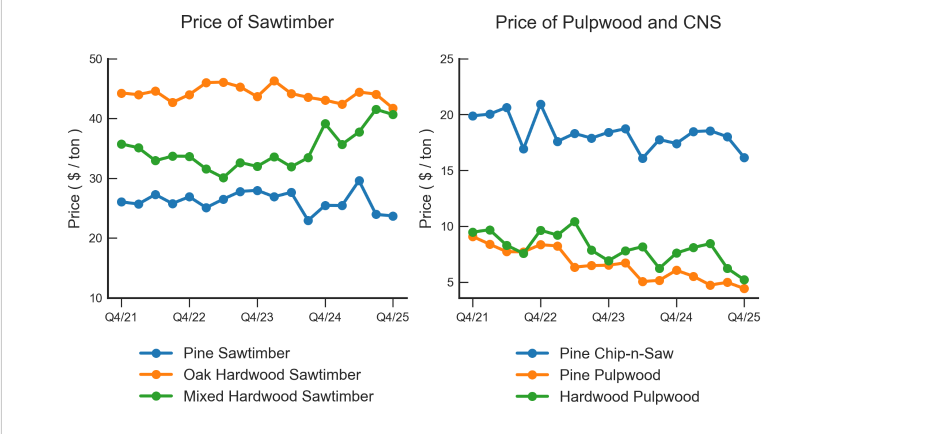
The stumpage prices below are the statewide averages and are intended to demonstrate the general trends in the market. The current value of timber can differ greatly across parishes, species, tree quality, market access, and other factors. Forest landowners considering a timber sale are encouraged to contact a consulting forester for assistance. Average stumpage prices for the six major products for the 4th Quarter-2025 were reported as follows:
Average stumpage prices*($/ton) Q4/2025
| Stumpage | Q4/2025 | Q3/2025 | Q4/2024 | Q4/Q3 % Change | Q4/Q4 % Change |
|---|---|---|---|---|---|
| Pine Sawtimber | 23.70 | 23.95 | 25.46 | -1.0% | -6.9% |
| Oak Sawtimber | 41.70 | 44.06 | 43.05 | -5.4% | -3.1% |
| Mixed Hardwood Sawtimber | 40.66 | 41.52 | 39.14 | -2.1% | +3.9% |
| Pine Chip-n-Saw | 16.16 | 18.02 | 17.41 | -10.3% | -7.2% |
| Pine Pulpwood | 4.43 | 4.99 | 6.07 | -11.2% | -27.0% |
| Hardwood Pulpwood | 5.21 | 6.25 | 7.60 | -16.6% | -31.4% |
* Oak Sawtimber includes both red oak and white oak species. The sawtimber and pulpwood price data included in this newsletter are published with permission from TimberMart-South Athens, GA 30605 email tmart@timbermart-south.com.
— This document is intended for use by forestry stakeholders of Louisiana. The source of these prices is proprietary in nature.
In the fourth quarter of 2025, Louisiana’s timber market experienced broad declines across all product categories. Pine Sawtimber prices decreased 1.0% to $23.70 per ton, remaining relatively flat from the previous quarter but down 6.9% from a year ago. The pulpwood market continued to weaken significantly, with Pine Pulpwood falling 11.2% to $4.43 per ton and Hardwood Pulpwood dropping 16.6% to $5.21 per ton. Year-over-year, Pine Pulpwood is down 27.0% and Hardwood Pulpwood is down 31.4%, representing the lowest levels in over two decades. Pine Chip-n-Saw experienced a notable correction of 10.3% to $16.16 per ton. Oak Sawtimber declined 5.4% to $41.70 per ton, while Mixed Hardwood Sawtimber posted the only year-over-year gain at 3.9%, reaching $40.66 per ton.
Mill closure effects continue to show in Louisiana’s pulpwood market. The April 2025 closure of International Paper’s Red River mill in Campti removed 1.6 million tons of annual pulpwood demand from the region. This followed the 2019 closure of Georgia-Pacific’s Port Hudson mill, which reduced hardwood pulpwood buying in southeast Louisiana. With the nearest paper mills now often 100 miles or more away, transportation costs can exceed the product’s value, leaving many loggers without practical market options. Some loggers report leaving pulpwood behind in the woods because it does not make financial sense to haul it. By comparison, Alabama’s active mill infrastructure—including Georgia-Pacific’s ongoing $800 million expansion at its Alabama River Cellulose mill—creates more competition for wood, which helps explain why Alabama’s hardwood pulpwood price sits at $17.79/ton compared to Louisiana’s $5.21/ton.
Looking ahead to 2026, the Louisiana timber market is expected to see gradual adjustment rather than rapid recovery. Housing starts are forecast between 1.35 and 1.50 million units, with mortgage rates expected to remain above 6% for much forests continue to grow approximately 40% more wood annually than is harvested. Combined tariffs on Canadian lumber now exceeding 45% offer some protection for domestic producers, though the structural oversupply across the South limits how much prices can rise. Pine sawtimber prices are expected to remain in the $23-28 per ton range, with potential for modest improvement if housing activity increases. The pulpwood market faces no near-term recovery, as the paper industry’s shift toward recycled fiber represents permanent change rather than a temporary downturn.
Robbie Hutchins, Area Forestry and Wildlife Agent, LSU AgCenter
“What happened to my sassafras trees?” I am asked that quite often.
Sassafras trees (Sassafras albidum), and other native trees, have been negatively affected by things like storm damage and drought over the last few years. For sassafras trees, the main culprit is something new, different, and invasive. Across Louisiana, sassafras trees are dying because of laurel wilt, a devastating disease caused by the fungus Raffaelea lauricola, and spread by the invasive exotic redbay ambrosia beetle (Xyleborus glabratus). The disease vector, the redbay ambrosia beetle, is native to Asia and was introduced through a port in Georgia in 2002 and laurel wilt disease was discovered soon afterwards.
Laurel wilt was first discovered in Louisiana in 2014 on mature sassafras trees in Union Parish. Since the initial discovery, laurel wilt has continued to spread and has now been officially confirmed in 14 parishes. Extension experts with the LSU AgCenter believe laurel wilt is likely present in most Louisiana parishes but has either not been found or not officially reported at this time.
Laurel wilt is an invasive fungal disease that attacks trees in the Lauraceae family which includes common Louisiana trees such as sassafras, red bay, and cherry laurel. Laurel wilt also attacks non-native trees in the same family such as avocado and camphor tree. Laurel wilt is carried on the body of the redbay ambrosia beetle and infects trees as the beetle bores
reddish-brown, and the entire canopy browns while leaves often stay on the branches for months. Cutting away bark of infected trees show dark-stained sapwood, a very clear sign of infection. There are two obvious external signs that a sassafras tree has been attacked by redbay ambrosia beetles. Infected trees will have small pinhole tunnels and fine “toothpick” or “pencil lead” like tubes of sawdust protruding from the bark where beetles bore in. One may also be able to see the beetles themselves which are tiny (only about 2 mm or the width of a debit card), brown to black, and cylinder-shaped. Even though sassafras isn’t really an economically significant tree species, sassafras is very important to many people because of its environmental and cultural significance to Louisiana. The fruit of the sassafras is a soft drupe and is an important soft mast food for wildlife such as wild turkeys, songbirds, and grey squirrels. Sassafras is vital to our signature Louisiana cooking too. Sassafras leaves are harvested, dried, and ground into a powder to make file’ for gumbo, sassafras roots were used by Native peoples and settlers to make medicinal tonics, its oil flavored teas and traditional root beer, and sassafras wood is often used to smoke sausage, andouille, and tasso.
Here are some simple tips to help slow the spread of the redbay ambrosia beetle and laurel wilt:
Staying vigilant can help in the fight against the invasive redbay ambrosia beetle and laurel wilt. Who knows. You may be the one that protects the future of the sassafras trees we rely on to help preserve the uniqueness of our cuisine, our culture, and our heritage.
If you have any questions please feel free to contact me at rhutchins@agcenter.lsu.edu or check out our website at www.lsuagcenter.com.
Whitney Wallace, Area Forestry Agent, LSU AgCenter
Tax season can be stressful, but planning ahead can save Louisiana forest landowners time and money. According to the U.S. Forest Service’s 2024 Tax Tips for Forest Landowners, the first step is knowing how your property is classified as personal use, investment, or business. This classification determines what expenses you can deduct, and which forms you may need. Even if you only sell timber occasionally, keeping good records like maps, receipts, and contracts is essential.
One form that often comes up is IRS Form T (Timber). The IRS explains that Form T is required if you claim depletion, make certain timber elections, or sell standing timber under special rules. Even if you don’t file Form T, the Forest Service stresses the importance of establishing your timber basis, the original value of your timber when you acquired the land. Basis allows you to claim depletion, which reduces taxable income when you sell timber.
Reforestation costs can also provide tax benefits. According to the IRS and Forest Service guidance, landowners may deduct up to $10,000 of qualified reforestation expenses per property in the first year, with the remainder amortized over 84 months. This includes site preparation, seedlings, and planting. Keeping receipts and noting dates of work will help you claim these deductions correctly. If you plan to sell timber, how you sell matters. Lump-sum or pay-as-cut contracts may qualify for long-term capital gains treatment if you’ve owned the timber for more than a year. The Forest Service notes that this usually means a lower tax rate compared to ordinary income. Ask your tax preparer whether a special election under IRS rules could benefit you. For help staying organized, the USFS Timber Tax website offers free checklists and worksheets for tracking timber basis, depletion, and reforestation costs. These tools make it easier to keep accurate records and prepare for tax season. Finally, finding the right tax professional is important. Louisiana Extension recommends asking questions like: - Do you have experience preparing returns for forest landowners? - Are you familiar with Form T, timber basis, and reforestation deductions? - Can you represent me in an IRS audit? Choosing someone who understands forestry taxation can save you money and prevent costly mistakes. For more resources, visit the USFS Timber Tax website or contact your local Louisiana Extension office for additional information or help with finding resources.
Luke Stamper, PhD, Extension Wildlife Specialist, LSU AgCenter
Hunting season wrapped up for most of Louisiana in late January, with a few areas continuing into February for species such as deer, squirrel, and rabbit. As the pace of the season slows and the woods settle down, now is an ideal time to turn your attention toward post-season management. This is when the to-do list you built during the fall can start becoming actionable. For deer managers, any harvest data collected over the past several months should be compiled and reviewed, preferably with the help of a professional wildlife biologist. These data help determine whether you’re meeting long-term goals like improving buck age structure, increasing fawn recruitment, or managing herd density, and they provide the insight needed to fine-tune your management strategy for the year ahead. Progress may not always be linear, but adapting your approach season by season is part of what makes wildlife management rewarding.
It’s also time to begin planning warm season food plots as winter transitions to early spring here in the deep south. Considerations such as location, acreage, and the forage species you intend to plant become increasingly important as the planting window approaches. Collecting soil samples now is a smart investment in the success of your plots. Local LSU AgCenter Extension offices provide soil sampling kits, guidance on proper sampling techniques, and assistance interpreting results. With those results in hand, you can make informed fertility decisions tailored to the forages you’ve selected, laying the groundwork for productive plots later in the growing season.
Waterfowl managers may still notice ducks using managed impoundments in late winter as they search for energy-dense foods ahead of their northern migration. Keeping water levels stable during this period can benefit several species as they build reserves for the long journey ahead. Soon after, early spring brings the question of when to initiate drawdowns in moist-soil units. A well-timed drawdown encourages the growth of high-quality natural foods that are critical for next year’s waterfowl season. Planning this step now helps ensure habitat is primed for robust seed production and favorable plant communities later in the year.
As you move into the growing season, taking advantage of this quieter period to review, plan, and prepare can set the stage for successful habitat management throughout the year. Good luck with all your management endeavors in the months ahead!
Upcoming Events
| Region | Title | Date | Contact |
|---|---|---|---|
| Northeast | Northeast Forestry Forum | March 27, 2026 | lstamper@agcenter.lsu.edu |
| Northwest | Ark-La-Tex Forestry Forum | March 10,2026 | vwest@agcenter.lsu.edu |
| Southeast | Florida Parishes Forestry Forum | March 4, 2026 | wwallace@agcenter.lsu.edu |
| Central | CENLA Forestry Forum | April 2, 2026 | rhutchins@agcenter.lsu.edu |
Contact your area agent/specialist for more information
| Name | Region | Title | Contact |
|---|---|---|---|
| Luke Stamper, PhD | Statewide | Extension Wildlife Specialist | lstamper@agcenter.lsu.edu |
| Jinggang Guo, PhD | Statewide | Forest Economist | jguo@agcenter.lsu.edu |
| Valerie West, PhD | Northwest | Extension Forestry/Wildlife Agent | vwest@agcenter.lsu.edu |
| Robbie Hutchins | Central/Southwest | Extension Forestry/Wildlife Agent | rhutchins@agcenter.lsu.edu |
| Whitney Wallace | Southeast | Extension Forestry/Wildlife Agent | wwallace@agcenter.lsu.edu |
For more information, contact your local Parish LSU AgCenter Office
Office Hours: Monday – Friday 8:00 a.m. – 4:30 p.m.
For the latest research-based information on just about anything, visit our website:
LSUAgCenter.com
The LSU AgCenter and LSU provide equal opportunities in programs and employment.


 TimberTales_Q1 - 2026pdf / 0.50MB