Search
The past several issues of GNOGardening Magazine contained articles on pesticides generally considered less toxic and more environmentally friendly such as horticultural oils, insecticidal soaps, Neem, diatomaceous earth and kaolin clay. Several of these fall into the category of “biopesticides” defined by the EPA as “certain types of pesticides derived from such natural materials as animals, plants, bacteria, and certain minerals.” This category is further divided into three classes:
The most widely used microbial pesticides are subspecies and strains of Bacillus thuringiensis, or Bt. Each strain of this bacterium produces a different mix of proteins and specifically kills one or a few related species of insect larvae. While some Bt ingredients control moth larvae found on plants, other Bt ingredients are specific for larvae of flies and mosquitoes. The target insect species are determined by whether the particular Bt produces a protein that can bind to a larval gut receptor, thereby causing the insect larvae to starve.

Image shows Bacilus thuringiensis bacteria magnified 4,000 times.
In the next few issues, we will concentrate on microbial pesticides – what they are, how they work, how to use them, etc. As mentioned above, the most widely known and used microbial pesticide is commonly called Bt. In the common vernacular, Bt refers to the group of Bacillus thuringiensis subspecies and the spores they produce that contain delta endotoxins. There are at least four subspecies that are currently used for their insecticidal properties: B.t. subsp. kurstaki, B.t. subsp. israelensis, B.t. subsp.
tenebrionis and B.t. subsp. aizawa. Bacillus thuringiensis is a common, soil-dwelling bacterium that occurs naturally in the gut of caterpillars of moths and butterflies, as well as on leaf surfaces, in aquatic environments, in animal feces, in insect-rich environments, and in flour mills and grain-storage facilities. Insecticidal activity was first noticed in 1901 in silkworms dying in Japan. The bacterium causing the collapse was isolated and named Bacillus sotto. It was rediscovered in 1911 in the German state of Thuringia killing flour moths and thus named Bacillus thuringiensis. Farmers started to use Bt as a pesticide in 1920. Commercial spore-based formulations called Sporine were produced in France beginning in 1938. Sporine, at the time was used primarily to kill flour moths. In the US, Bt was used commercially starting in 1958 and first registered by the EPA in 1961. Up until 1977, only thirteen Bt strains had been described. All thirteen were toxic only to certain species of lepidopteran larvae. In 1977 the first subspecies toxic to dipteran (flies) species was found, and the first discovery of strains toxic to species of coleopteran (beetles) followed in 1983. In 1976, it was found that endospore and crystal protein formation were encoded by genes carried on a plasmid (extrachromosomal circular DNA common in many bacteria). In fact, Bacillus thuringiensis, Bacillus cereus (common soil bacterium) and Bacillus anthracis (the cause of anthrax) differ primarily in the plasmids they
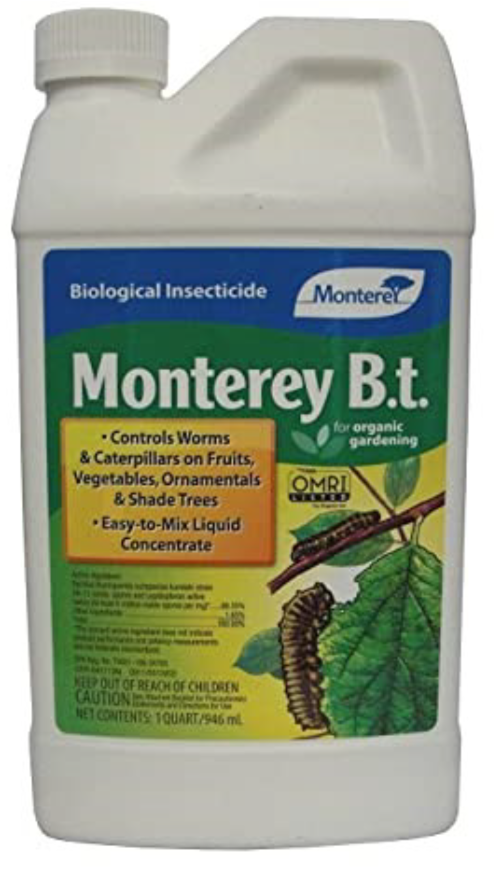
Image shows an example of a commercially available pesticide containing Bacillus thuringiensis.
harbor. These crystalline proteins are commonly called Cry proteins and the majority of cry protein genes are located on plasmids. Cry proteins or toxins have specific activities against insect species of the orders Lepidoptera (moths and butterflies), Diptera (flies and mosquitoes), Coleoptera (beetles) and Hymenoptera (wasps, bees, ants and sawflies), as well as against some nematodes. When insects ingest toxin crystals, their alkaline digestive tracts denature the insoluble crystals, making them soluble and thus amenable to being cut with proteases found in the insect gut. This cleavage activates the Cry toxin which is then inserted into the insect gut cell membrane, paralyzing the digestive tract and forming a pore. The insect stops eating and starves to death. In 1996 another class of insecticidal proteins in Bacillus thuringiensis was discovered: the vegetative insecticidal proteins or Vip. Vip proteins are different from Cry proteins, have different receptors, and some kill different insects. Spores and crystalline insecticidal proteins produced by B. thuringiensis have been used to control insect pests since the 1920s and are often applied as liquid sprays. Some common trade names are DiPel and Thuricide but they are sometimes just labeled Bt. Because of their specificity, these pesticides are regarded as environmentally friendly, with little or no effect on humans, wildlife, pollinators, and most other beneficial insects, and are used in organic farming. CEASE is an EPA registered product that is sold as a
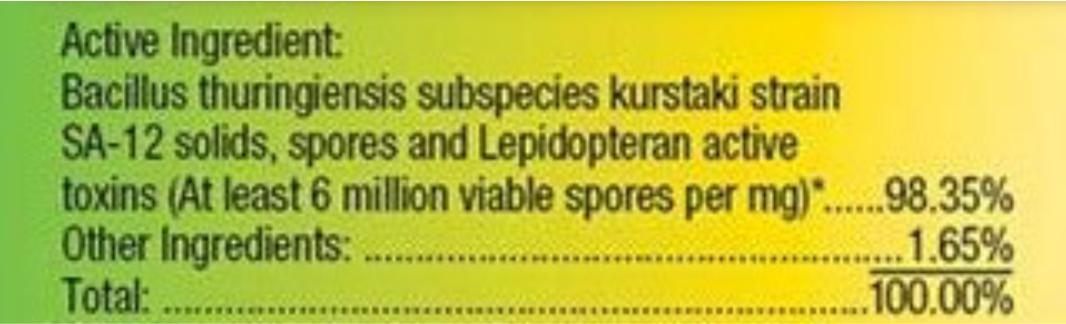
The active ingredients from the Monterey B.t. Notice that it contains the kurstaki strain of B.t.
biofungicide with a patented strain of Bacillus thuringiensis as the active ingredient. From the label: “CEASE can be used for organic production and targets common fungal diseases such as Botrytis, Powdery Mildew, Anthracnose, Didymella bryoniae (Gummy Stem Blight) and several leaf spot diseases such as Alternaria and Entomosporium. CEASE also controls bacterial diseases such as Pseudomonas, Erwinia, and Xanthomonas spp., as well as the soil diseases Rhizoctonia, Pythium, Fusarium and Phytophthora. CEASE is a contact biological fungicide containing a patented strain of the bacterium Bacillus subtilis which works in two ways. First, the bacterial spores occupy space on the plant surface and compete with the pathogens; then active compounds called lipopeptides produced by each bacterium disrupt the germination and growth of invading pathogens.” In studies I’ve been able to locate, thus far, CEASE was only moderately effective.
Bacillus pumilus strain GB34 is used as an active ingredient in agricultural fungicides. The bacterium colonizes plant root hairs and prevents Rhizoctonia and Fusarium spores from germinating. B. pumilus is a common soil bacterium on soybean roots. Yield Shield is a concentrated form of the GB34 strain from Bayer sold as a seed treatment for a multitude of plants for suppression of Rhizoctonia and Fusarium root diseases.
Bacillus thuringiensis subsp. israelensis (Bti) is used across the United States for mosquito control. Bti is approved for aerial spraying, can be sprayed over waterbodies such as ponds, lakes, rivers and streams. Bti is used to kill developing mosquito larvae in standing water where those larvae are found. Bti can be used around homes in areas and containers where water can collect, such as flowerpots, tires, and bird baths. Bti can also be used to treat larger bodies of water like ponds, lakes and irrigation ditches.
One of the more important points to remember when using Bt products is that in order to work, the insect must ingest the product. Therefore, if a part of the plant isn’t sprayed, it isn’t protected. Most formulations contain surfactant and sticker components that help the material spread further and remain for long periods (it becomes rain-fast). Most also include agents to protect the spores and crystals from UV light. UV light and alkaline conditions rapidly break down the crystalline proteins.
When applying the product always read and follow the label directions. It is important to get full coverage, top and bottom. Additionally, new growth will not be protected and reapplications are necessary. All the products I’ve looked at labelled for use on edible crops have a 0 REI (re-entry interval) and can be applied up to the day of harvest. There are currently over 180 registered products that contain Bt. It has been used and researched for almost 50 years and is still considered one of the safest, most effective, most environmentally friendly pesticides available.
~Dr. Joe Willis
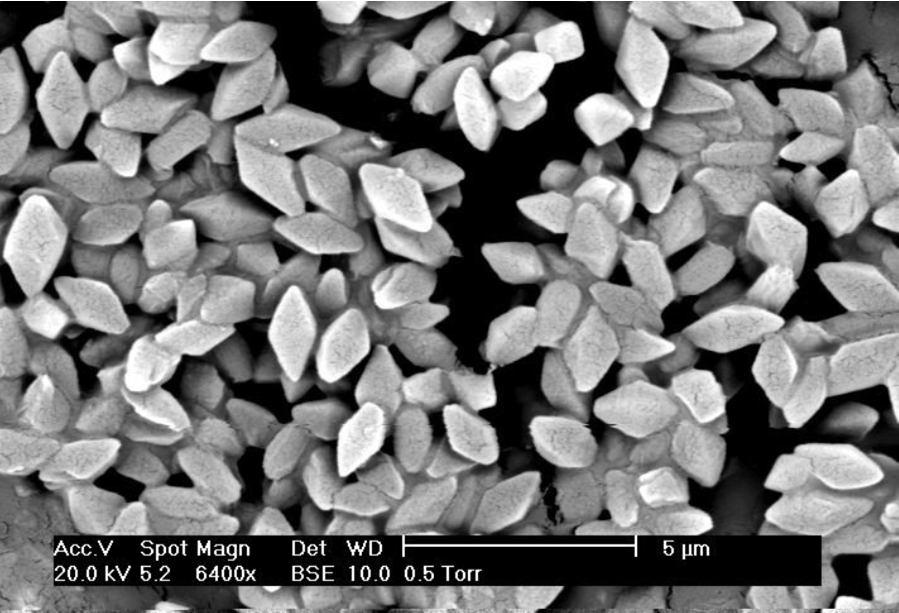
Microscopic view of B.t. crystalline proteins magnified 6,400 times.