Search
Mexican Rice Borer - Eoreuma loftini (Dyar)
mrb 1
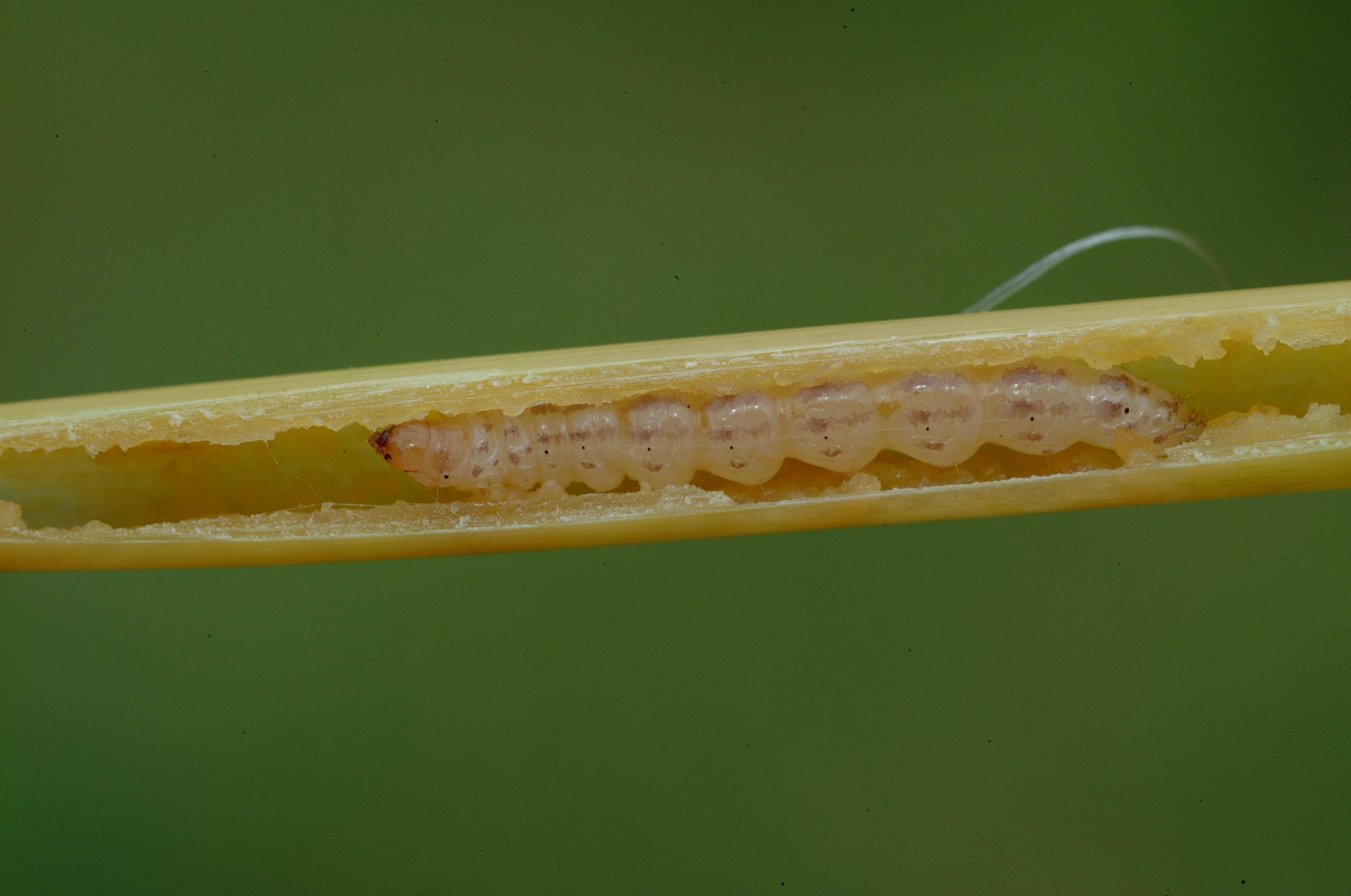
Title: Mexican rice borer larva
Short description: Mexican rice borer larva in rice stem.
Caption: The Mexican rice borer is a devastating pest of sugarcane and a serious rice pest. Young larvae feed on the tissue inside the leaf sheath and quickly migrate from oviposition site to bore into the rice stem after about one week of feeding. Larvae are honey-colored with two pairs of stripes running the length of body. Pupation take place inside the rice stem after mature larvae have constructed an emergence hole covered by one or two layers of plant tissue.
Photo credit: J. Saichuk
mrb 2
Title: Mexican rice borer moth
Short description: Mexican rice borer moth rests on a johnsongrass leaf.
Caption: Adult Mexican rice borers are light tan moths with delta-shaped wings. By comparison sugarcane borer adults are larger, straw-colored moths about ¾ inch long with a series of black dots arranged in an inverted V shape pattern on the front wings.
Photo credit: A. Meszaros
mrb 3
Title: Mexican rice borer eggs
Short description: Mexican rice borer egg cluster laid on a johnsongrass stem under the leaf sheath.
Caption: Mexican rice borer eggs are spherical, globular, cream-colored eggs hidden between the folds of dried leaves.
Photo credit: J. Beuzelin
mrb 4
Title: Mexican rice borer eggs 2
Short description: Mexican rice borer egg cluster on a dry johnsongrass leaf.
Caption: Mexican rice borer eggs are spherical, globular, cream-colored eggs often hidden between the folds of dried leaves.
Photo credit: J. Beuzelin
mrb 5
Title: Stem borer feeding signs
Short description: Orange discoloration of the leaf sheath due early instar stem borer feeding.
Caption: After hatching, young larvae feed inside fresh leaf sheaths. Feeding of early instar of sugarcane borer and Mexican rice borer cause the same type of injury manifesting in an orange discoloration of the leaf sheath.
Photo credit: J. Saichuk
mrb 6
Title: Stem borer feeding signs 2
Short description: Orange discoloration of the leaf sheath due early instar stem borer feeding.
Caption: After hatching, young larvae feed inside fresh leaf sheaths and then bore into the stem or stalk. Feeding of early instar of sugarcane borer and Mexican rice borer cause the same type of injury manifesting in an orange discoloration of the leaf sheath.
Photo credit: J. Saichuk
mrb 7
Title: Stem borer feeding signs 3
Short description: Orange discoloration of the leaf sheath due early instar stem borer feeding.
Caption: After hatching, young larvae feed inside fresh leaf sheaths and then bore into the stem or stalk. Feeding of early instar of sugarcane borer and Mexican rice borer cause the same type of injury manifesting in an orange discoloration of the leaf sheath.
Photo credit: J. Saichuk
mrb 8
Title: Sugarcane borer vs. Mexican rice borer feeding injury
Short description: 1st instar stem bores feeding injury: Sugarcane borer (left) vs. Mexican rice borer (right). At this stage there is no difference among injuries of different species of stalk borers.
Caption: After hatching, young larvae feed inside fresh leaf sheaths. Feeding of early instar of sugarcane borer and Mexican rice borer cause the same type of injury manifesting in an orange discoloration of the leaf sheath. At this stage there is no difference among injuries of different species of stalk borers, but as Mexican rice borer larvae bore into the stem or stalk, they pack tunnels with frass, which prevents the entry of predators or parasites.
Photo credit: N. Hummel (left) and A. Meszaros
mrb 9
Title: Mexican rice borer larva
Short description: Mexican rice borer larva (approx. 4th instar).
Caption: Mexican rice borer larva (approx. 4th instar) on a split sugarcane stalk. As the larvae bore into the stem or stalk, they pack tunnels with frass, which prevents the entry of predators or parasites.
Photo credit: A. Meszaros
mrb10
Title: Mexican rice borer larva 2
Short description: Mexican rice borer larva (approx. 4th instar).
Caption: Mexican rice borer larva (approx. 4th instar) on a split sugarcane stalk.
Photo credit: J. Saichuk
mrb11
Title: Mexican rice borer larva 3
Short description: Mexican rice borer larva (approx. 4th instar).
Caption: Mexican rice borer larva (approx. 4th instar) bored into a vasey grass stem.
Photo credit: A. Meszaros
mrb12
Title: Mexican rice borer larva 4
Short description: Mexican rice borer larva (approx. 5th instar).
Caption: Mexican rice borer larva (approx. 5th instar) on a sugarcane leaf.
Photo credit: A. Meszaros
mrb13
Title: Mexican rice borer larva 5
Short description: Mexican rice borer larva (approx. 4th instar).
Caption: Mexican rice borer larva (approx. 4th instar) on a split sugarcane stalk.
Photo credit: A. Meszaros
mrb14
Title: Mexican rice borer larva 6
Short description: Mexican rice borer larva (approx. 4th instar).
Caption: Mexican rice borer larva (approx. 4th instar) on a split sugarcane stalk.
Photo credit: A. Meszaros
mrb15
Title: Dead heart
Short description: Dead heart is when the youngest partially unfurled leaf of the plant begins to whiter and die.
Caption: Injury is often first noticed when the youngest partially unfurled leaf of the plant begins to whiter and die, resulting in a condition called dead heart. Dead heart can be caused by any stem borer.
Photo credit: J. Saichuk
mrb16
Title: Dead heart 2
Short description: Dead heart is when the youngest partially unfurled leaf of the plant begins to whiter and die.
Caption: Injury is often first noticed when the youngest partially unfurled leaf of the plant begins to whiter and die, resulting in a condition called dead heart. Dead heart can be caused by any stem borer.
Photo credit: A. Meszaros
mrb17
Title: Dead heart 3
Short description: Dead heart is when the youngest partially unfurled leaf of the plant begins to whiter and die.
Caption: Injury is often first noticed when the youngest partially unfurled leaf of the plant begins to whiter and die, resulting in a condition called dead heart. Dead heart can be caused by any stem borer.
Photo credit: A. Meszaros
mrb18
Title: White head
Short description: White head caused by stem borer.
Caption: Stem feeding that occurs during panicle development often causes partial or complete sterility and results in white head. The white empty panicles are light in weight and stand upright.
Photo credit: J. Saichuk
mrb19
Title: White head 2
Short description: White head caused by stem borer.
Caption: Stem feeding that occurs during panicle development often causes partial or complete sterility and results in white head. The white empty panicles are light in weight and stand upright.
Photo credit: J. Saichuk
mrb20
Title: Mexican rice borer larva (left) vs. rice stalk borer (right)
Short description: Mexican rice borer larva (left) vs. rice stalk borer (right)
Caption: Mexican rice borer larvae are honey-colored with two pair of dark purple stripes running the length of the body. They have light brown head capsule (except early instars) and light colored hairs.
Photo credit: A. Meszaros (Mexican rice borer) and J. Saichuk (rice stalk borer)
mrb21
Title: Mexican rice borer larva vs. rice stalk borer
Short description: Mexican rice borer larva (top) vs. rice stalk borer (bottom)
Caption: On the meso-and metathorax of the larva (right above the “prolegs”), the Mexican rice borer has only one seta (hair), while the rice stalk borer has two setae. Ref: KEY TO SELECTED PYRALOIDEA (LEPIDOPTERA) LARVAE INTERCEPTED AT U. S. PORTS OF ENTRY: REVISION OF PYRALOIDEA IN “KEYS TO SOME FREQUENTLY INTERCEPTED LEPIDOPTEROUS LARVAE” BY WEISMAN, 1986, M. ALMA SOLIS. Also, in general, the Mexican rice borer has light colored hairs and head capsule while the rice stalk borer has dark hairs and head capsule.
Photo credit: A. Meszaros
mrb22
Title: Mexican rice borer larva (left) vs. Sugarcane borer larva (right)
Short description: Mexican rice borer larva (left) vs. Sugarcane borer larva (right) on a split sugarcane stalk.
Caption: Sugarcane borer larvae are pale yellow-white in the summer, with a series of brown spots visible on the back. Overwintering larva are a deeper yellow and lack of the brown spots.
Mexican rice borer larvae are honey-colored with two pair of stripes running the length of the body. They have light brown head capsule (except early instars) and light colored hairs.
Photo credit: B. Schultz.
mcb23
Title: Mexican rice borer pupa (left) vs. sugarcane borer pupa (right)
Short description: Mexican rice borer pupa (left) vs. Sugarcane borer pupa (right) on a sugarcane leaf.
Caption: Pupation takes place inside the stem or stalk after mature larvae have made moth emergence holes that are smaller than those made by the sugarcane borers in sugarcane. The pupae of sugarcane borer are brown, about 1 inch long and roughly cylindrical in shape, not smoothly tapered as rice stalk borer or Mexican rice borer pupae.
Photo credit: A. Meszaros
mcb24
Title: Mexican rice borer pupa
Short description: Mexican rice borer pupa
Caption: Pupation takes place inside the stem or stalk after mature larvae have made moth emergence holes that are smaller than those made by the sugarcane borers in sugarcane. The pupae of sugarcane borer are brown, about 1 inch long and roughly cylindrical in shape, not smoothly tapered as rice stalk borer or Mexican rice borer pupae.
Photo credit: A. Meszaros
mcb25
Title: Mexican rice borer pupa 2
Short description: Mexican rice borer pupa
Caption: Pupation takes place inside the stem or stalk after mature larvae have made moth emergence holes that are smaller than those made by the sugarcane borers in sugarcane. The pupae of sugarcane borer are brown, about 1 inch long and roughly cylindrical in shape, not smoothly tapered as rice stalk borer or Mexican rice borer pupae.
Photo credit: A. Meszaros
mrb 26
Title: Mexican rice borer moth 2
Short description: Mexican rice borer moth rests on a johnsongrass leaf.
Caption: Adult Mexican rice borers are light tan moths with delta-shaped wings. By comparison sugarcane borer adults are larger, straw-colored moths about ¾ inch long with a series of black dots arranged in an inverted V shape pattern on the front wings.
Photo credit: A. Meszaros
mrb 27
Title: Mexican rice borer pheromone trap
Short description: Mexican rice borer pheromone trap can assist in monitoring for Mexican rice borer adult in rice and sugarcane.
Caption: Adult Mexican rice borers are light tan moths with delta-shaped wings. By comparison sugarcane borer adults are larger, straw-colored moths about ¾ inch long with a series of black dots arranged in an inverted V shape pattern on the front wings.
Photo credit: A. Meszaros
mrb 28
Title: Mexican rice borer male moth in a pheromone trap
Short description: Mexican rice borer male moth is attracted by pheromone lure specific to Mexican rice borer.
Caption: Adult Mexican rice borers are light tan moths with delta-shaped wings. By comparison sugarcane borer adults are larger, straw-colored moths about ¾ inch long with a series of black dots arranged in an inverted V shape pattern on the front wings.
Photo credit: A. Meszaros
Click on the links above to go to the Mexican Rice Borer home page or the Rice Insects Photo Galleries home page.